What Most Tools Don't Check
- 1. Context
- 2. Legal / Regulatory Explanation
- 3. Practical Application
- 4. Common Misconceptions
- 5. Risk Scenarios
- 6. Evidence Regulators Look For
- 7. Closing Clarity
1. Context
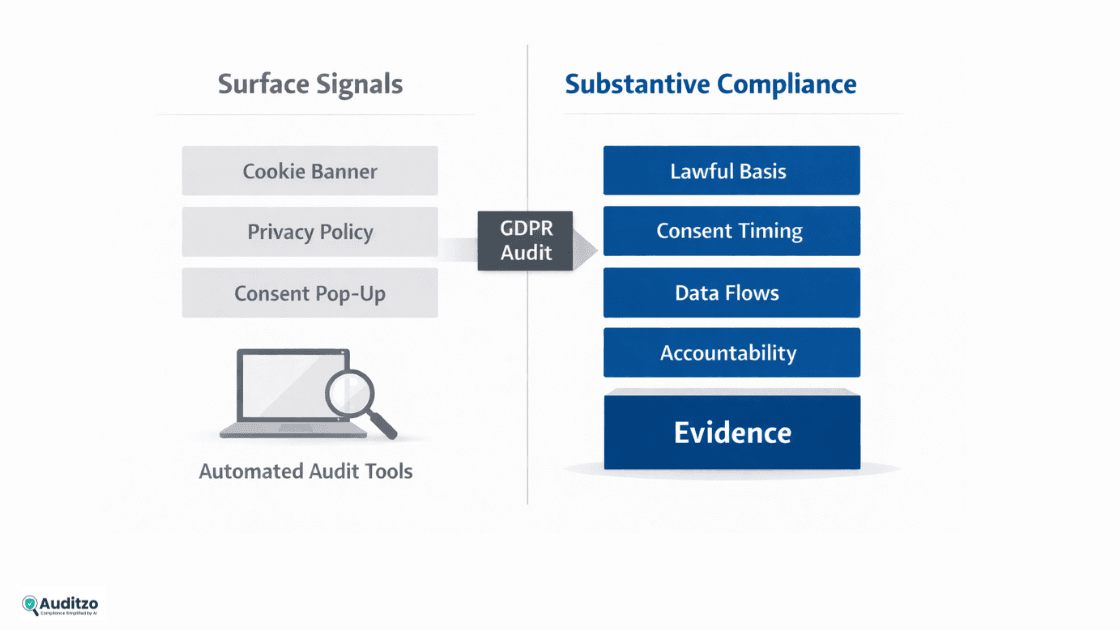
For many EU websites, a GDPR audit for EU websites begins and ends with an automated scan. These tools are designed to quickly flag visible elements such as cookie banners, privacy policy links, and consent pop-ups. This approach creates an initial sense of assurance and is often used as a proxy for compliance.
However, regulatory compliance is not determined by surface indicators alone. Organizations can appear compliant while still processing personal data unlawfully. A meaningful GDPR audit requires examining what actually happens behind the interface, how data is collected, when processing begins, and whether legal requirements are met in practice.
2. Legal / Regulatory Explanation
At a regulatory level, the GDPR does not define a standardized checklist for website compliance. Instead, it sets out principles and obligations that must be respected and, crucially, demonstrable, as established in the binding text of the General Data Protection Regulation (EU) 2016/679. An audit must therefore assess alignment with these principles rather than confirm the existence of predefined components.
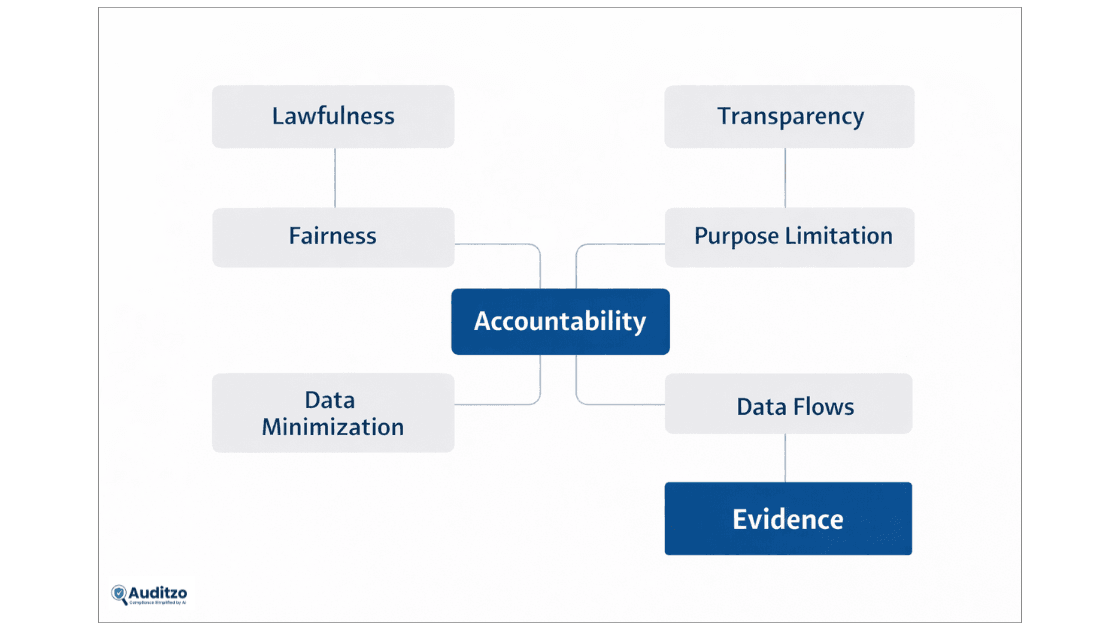
Key principles relevant to EU websites include lawfulness, fairness, transparency, purpose limitation, data minimization, and accountability. Each of these principles carries operational implications that extend beyond what an automated tool can detect.
Lawful processing is central to this assessment. Personal data may only be collected and processed when a valid legal basis applies. In many website contexts, this legal basis is consent. For consent to be valid, it must be freely given, specific, informed, and unambiguous, and it must be obtained before any processing occurs, consistent with GDPR cookie consent requirements articulated by EU regulators.
Accountability underpins all other obligations. Controllers are required not only to comply with the GDPR, but to be able to demonstrate that compliance. This involves maintaining documentation, logs, and other records that show how compliance decisions are implemented and enforced.
An audit that focuses solely on the presence of a cookie banner or a privacy policy fails to address these substantive requirements.
3. Practical Application
A practical GDPR audit starts by looking beyond declared intentions and examining actual data processing activities. This involves mapping what personal data is collected, at what point it is collected, and for which purposes. In many cases, data collection begins earlier than expected, such as during page load or through embedded third-party services.
Once processing activities are mapped, each activity must be assessed against its legal basis. This step requires verifying whether consent is necessary, whether consent has been properly obtained, and whether any alternative legal bases are genuinely applicable in the given context.
Consent verification is often where automated tools fall short. A banner's presence does not confirm that consent is valid. Auditors must examine consent timing, granularity, and withdrawal mechanisms, as well as whether processing is effectively blocked until valid consent is given. If scripts or trackers execute before user action, the compliance issue exists regardless of later consent.
Third-party integrations require similar scrutiny. Analytics, advertising, and customer support tools frequently process personal data. An audit must determine whether these parties act as processors or joint controllers and whether contractual, technical, and organizational safeguards are in place.
Finally, practical compliance depends on documentation. Records of processing activities, consent logs, vendor assessments, and internal policies provide the foundation for demonstrating compliance when challenged.
4. Common Misconceptions
A common misconception is that passing an automated GDPR scan means a website is compliant. Automated tools are limited to detecting what is visible or technically discoverable, not whether legal conditions are satisfied.
Another misunderstanding is that a cookie banner automatically creates valid consent. Consent that allows tracking before user action or combines multiple purposes without choice often fails GDPR requirements, as clarified by the Planet49 judgment of the Court of Justice of the European Union.
Some organizations assume that publishing a privacy policy is sufficient. While transparency is mandatory, a policy does not legitimize unlawful processing. Compliance depends on actual data flows and processing logic.
There is also a widespread belief that third-party tools are compliant by default. In practice, responsibility for compliance remains with the website operator, regardless of assurances provided by vendors.
| Assumption | Reality under GDPR |
|---|---|
| Passing an automated scan equates to compliance | Automated tools cannot confirm whether legal conditions are satisfied |
| A cookie banner ensures valid consent | Consent may still be invalid depending on timing, choice, and granularity |
| A privacy policy makes processing lawful | Processing may still be unlawful even if transparency is provided |
| Third-party tools are compliant by default | Responsibility for compliance remains with the website operator |
5. Risk Scenarios
Certain risk scenarios appear repeatedly in regulatory reviews. One involves analytics or marketing scripts that load before consent is obtained. Even if consent is collected later, early data transmission may still constitute unlawful processing.
Another risk arises from incomplete vendor oversight. Third-party tools that process personal data without proper agreements or safeguards expose the website operator to enforcement action.
Documentation gaps present an additional risk. An organization that cannot demonstrate compliance during an investigation may face violations even where some technical measures exist.
False confidence generated by automated audit results can further compound these risks by delaying corrective action and allowing non-compliant practices to continue.
- Scripts loading before consent
- Incomplete vendor agreements
- Missing compliance documentation
- Reliance on automated audit results
6. Evidence Regulators Look For
When assessing GDPR compliance, regulators focus on evidence rather than assertions. Investigations typically examine how and when personal data is processed and whether legal requirements are met in operational reality.
Relevant evidence includes consent records showing when and how consent was obtained, logs demonstrating that processing was blocked until consent, and technical artifacts that reflect data transmission behavior, such as those documented in GDPR evidence reports for cookie violations.
Documentation plays a central role in this evaluation, including the use of valid digital evidence for GDPR compliance. Records of processing activities, data protection impact assessments where applicable, and internal policies are used to assess accountability.
Vendor management evidence may also be reviewed, including data processing agreements and assessments of third-party compliance. Together, these materials help regulators determine whether compliance claims are substantiated.
| Evidence Category | Examples |
|---|---|
| Consent records | When and how consent was obtained |
| Logs | Proof that processing was blocked until consent |
| Records of processing activities | Documentation showing processing purposes and controls |
| Vendor management evidence | Data processing agreements and assessments |
7. Closing Clarity
A GDPR audit checklist for EU websites cannot be reduced to a simple list of detectable elements. Substantive compliance depends on lawful basis validation, consent timing, control over data flows, and the ability to demonstrate accountability.
Automated tools can support initial discovery, but they do not replace a structured audit grounded in legal requirements and evidence. Organizations that rely solely on surface-level checks risk overlooking significant compliance gaps.
A meaningful GDPR audit evaluates what the law requires in practice and whether a website's operations can withstand regulatory scrutiny.