1) Understanding GDPR Evidence Requirements
Under GDPR, processing personal data requires a lawful basis and informed consent where applicable. If trackers or identifiers fire before consent, that timeline itself can demonstrate non-compliance.
- Show cookies or pixels loading pre-consent and identify the domains involved.
- Record IP address capture or device identifiers transmitted without consent.
- Document third-party requests (analytics, ads, social pixels) with timestamps.
- Corroborate with consent logs showing that consent had not yet been given.
Key takeaway: Evidence must connect user interaction to unlawful data activity—clearly, chronologically and reproducibly.
Quick Q&A: Legal Basics
Q: Is dropping analytics cookies before consent a GDPR breach?
A: Yes. Processing personal data without a lawful basis—such as pre-consent tracking—can breach GDPR Articles 5, 6 and 7. In short: Any cookie placed before consent is a potential violation.
Q: What counts as “personal data” in cookie cases?
A: Identifiers like IP address, device IDs, and cookie values can be personal data when they relate to an identifiable user. In short: even technical IDs can qualify as personal data if traceable to a user.
For deeper legal background, see the GDPR.eu guidance on consent and the ICO’s cookies guidance.
2) Why Cookie Violations Matter in Court
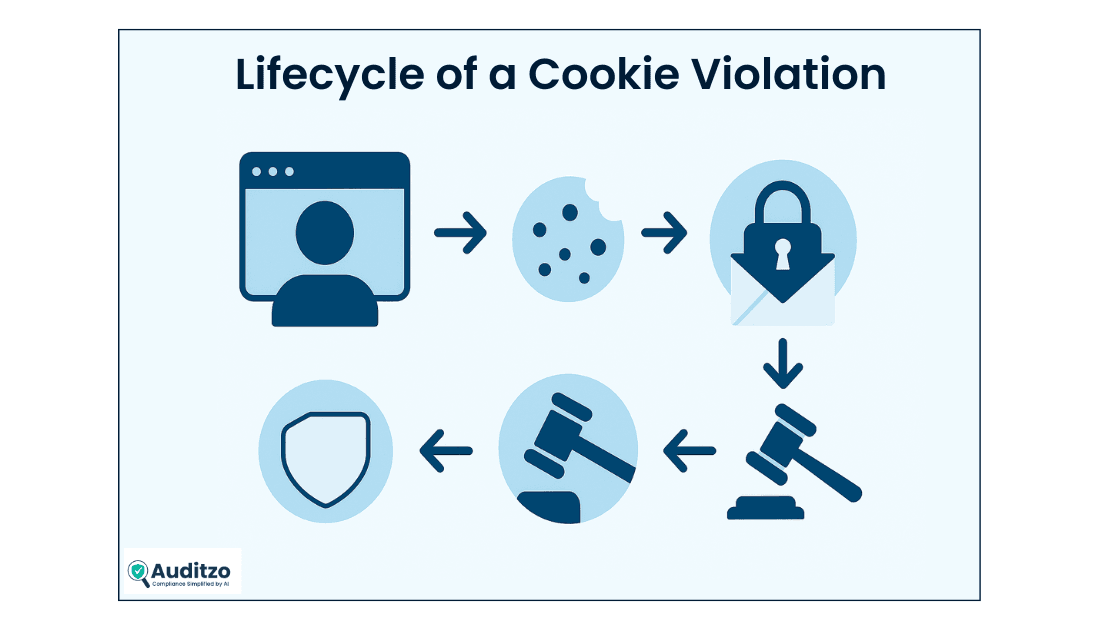
Cookie violations are visible, traceable, and enforceable. Supervisory authorities have issued substantial penalties where trackers fired early or consent flows used dark patterns.
“Cookie audits are the frontline of GDPR enforcement. They expose systemic consent flaws faster than any DPIA.” — Mark D’Souza, Compliance Advisor, London
Key takeaway: Pre-consent behaviour often becomes the starting point for broader investigations into profiling, remarketing and cross-border transfers. Refer to CNIL’s cookie compliance guidelines for regulator expectations.
Note: Don’t risk enforcement fines—automate your pre-consent evidence scan with Auditzo and secure defensible proof before authorities demand it.
3) What Makes an Evidence Report Courtroom-Ready
A strong GDPR evidence report doesn’t just list cookies—it demonstrates causality and legal relevance. Every detail must be traceable and supported by logs.
Essential components
- Precise timestamps for each event (page load, cookie set, consent click).
- Tracker details: domain, purpose, cookie name and value (hashed where appropriate).
- Consent timeline proving the trackers fired before the user consented.
- IP and device metadata captured (and when).
- Transmission logs to third-party services with endpoints and payload headers.
- Chain of custody: file hashes, time of capture, tools used, storage integrity.
Key takeaway: Every datapoint should map to a specific legal rule or standard (e.g., GDPR Articles 5–7, PECR, ePrivacy, or ISO evidence-handling norms).
Quick Q&A: Admissibility
Q: What makes digital evidence admissible for GDPR cases?
A: It must be timestamped, reproducible and authentic. Preserve raw logs (HAR, packet captures) and record tool versions and hashing. In short: Integrity and reproducibility make or break your evidence in court.
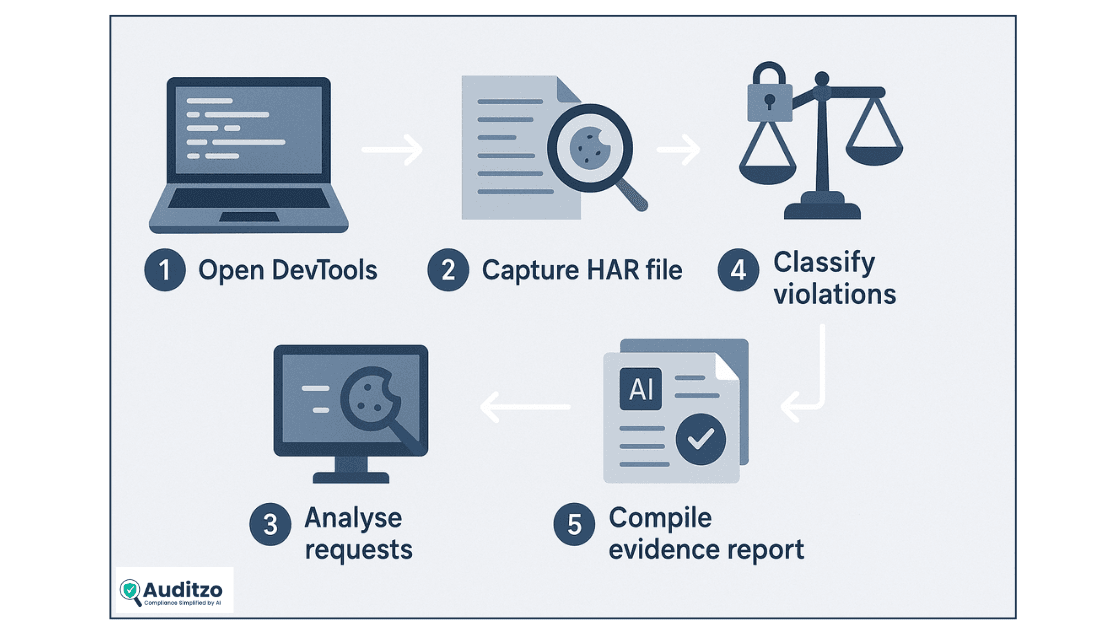
4) Step-by-Step: How to Document Cookie Violations
Use this practical workflow to capture and present facts with legal clarity.
Step 1: Detect pre-consent trackers
- Open Chrome DevTools → Network; enable “Preserve log” and hard refresh.
- Observe first-load network calls and note any third-party endpoints.
- Run Auditzo’s pre-consent scan to flag early-firing tags across domains.
Note: Look for `Set-Cookie` or analytics calls firing on the initial page load. In short: anything loading before consent equals unlawful processing.
Step 2: Capture raw evidence
- Export the HAR file after first page load.
- Take two screenshots: consent banner visible; network panel showing early calls.
- Record environment details (time, browser version, public IP).
- Optionally capture packets with Wireshark or Fiddler for IP-level corroboration.
Step 3: Analyse the data flow
- Identify cookies and pixels (e.g., analytics, remarketing, social).
- Check request/response headers for cookies or identifiers set pre-consent.
- List third-party destinations and purposes (analytics, ads, tag managers).
Step 4: Classify the violations
- Type A — cookie set pre-consent (e.g., analytics or advertising IDs).
- Type B — IP or device metadata captured pre-consent.
- Type C — data transmitted to third parties before any lawful basis exists.
Step 5: Write legal relevance
For each artefact, add an evidence summary and legal note:
- Evidence A2: Cookie `_fbp` loaded before user consent. Relevance: Processing without lawful basis (GDPR Articles 5 and 6).
- Evidence B1: IP address sent to analytics endpoint on first load. Relevance: Personal data transfer without consent (Article 6; transparency Article 5).
Key takeaway: Draft each item as a mini legal argument, not just a technical log. Judges appreciate concise, chronological, and clause-referenced proof.
Quick Q&A: Practicalities
Q: How often should cookie audits run?
A: Quarterly, and after major site changes. Trackers and tags change frequently. In short: schedule audits quarterly or after redesigns.
Q: What is the difference between a cookie scan and an audit?
A: A scan detects presence; an audit proves legality by correlating events with the consent timeline.
5) Inside Auditzo’s GDPR Evidence Report Template
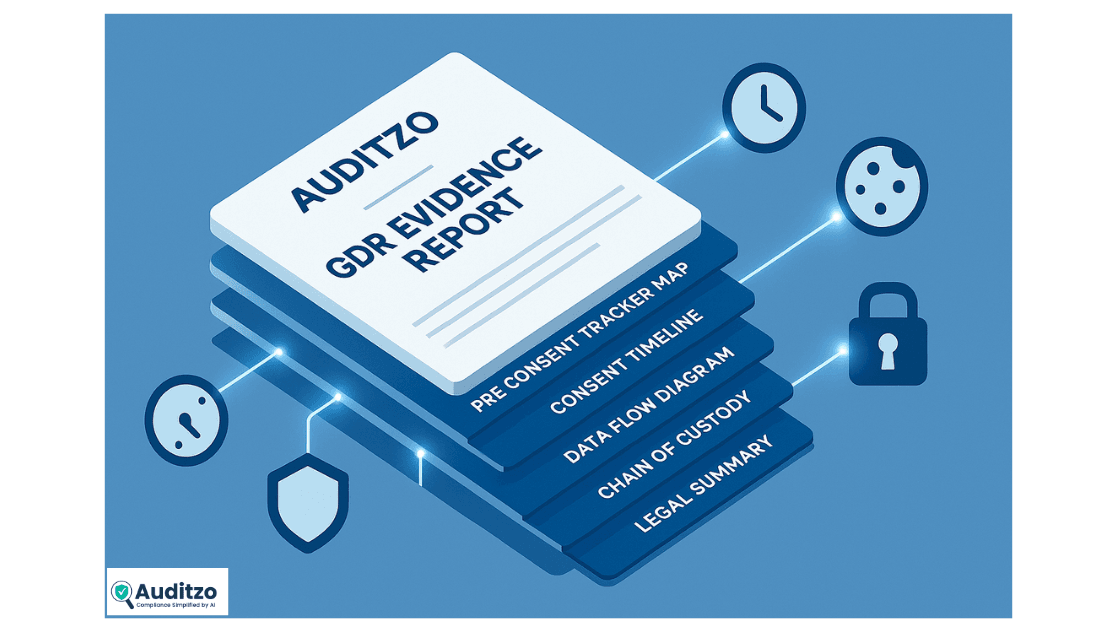
Auditzo converts raw browser and network artefacts into a standardised, defensible GDPR evidence report designed for regulators and litigation teams.
Core sections
- Pre-consent tracker map (visual index of early-firing tags).
- Consent timeline (click vs. tracker timestamps).
- Data-flow notes (outbound requests and endpoints).
- Evidence chain index (files, hashes, capture metadata, auditor).
- Legal summary (GDPR articles and enforcement context).
Key takeaway: AI-assisted tagging ensures consistency and reduces human error in evidence capture and reporting.
Already detecting violations? Automate your findings into a formatted, court-admissible report with Auditzo’s AI-powered template—trusted by over 50 legal teams worldwide.
Quick Q&A: Why AI for legal evidence?
Q: Why use an AI-based template instead of manual documentation?
A: It guarantees consistency, complete timelines and hash-verified artefacts—accelerating regulatory submissions and litigation readiness. In short: AI keeps evidence consistent, compliant, and court-ready.
6) Technical Tools for Forensic Accuracy
- HAR files (DevTools): Baseline record of network requests/responses.
- Wireshark: Packet-level capture to validate IP/data transfers.
- Fiddler: Deep inspection of headers and payloads for cookie sync.
- Consent manager logs: Cross-check consent status and timing.
- Auditzo scanner: Automated multi-source capture, hashing and report generation.
For regulator perspectives and recent penalties, review the IAPP Enforcement Tracker.
7) Best Practices for Law Firms and DPOs
Do
- Preserve original HAR, screenshots and packet captures; store securely.
- Timestamp and hash artefacts (e.g., SHA-256) to maintain integrity.
- Record tool versions, system time and environment details in the report.
Don’t
- Modify logs or mix test and production captures in one evidence set.
- Ignore mismatches between consent logs and network activity.
- Rely on screenshots alone without underlying machine-readable logs.
Key takeaway: Treat GDPR evidence like digital forensics—methodical capture, secure storage, and a clear chain of custody.
8) Common Mistakes (and How Auditzo Prevents Them)
- Only collecting screenshots without underlying HAR or packet data.
- Missing timestamps or failing to document consent state at capture time.
- Unsecured storage and no hash integrity checks.
Note: Auditzo automates timestamping, hashing, secure archiving and templated legal mapping—reducing risk and time-to-submission.
9) Case Example: Pre-Consent Tracker in a Real Audit
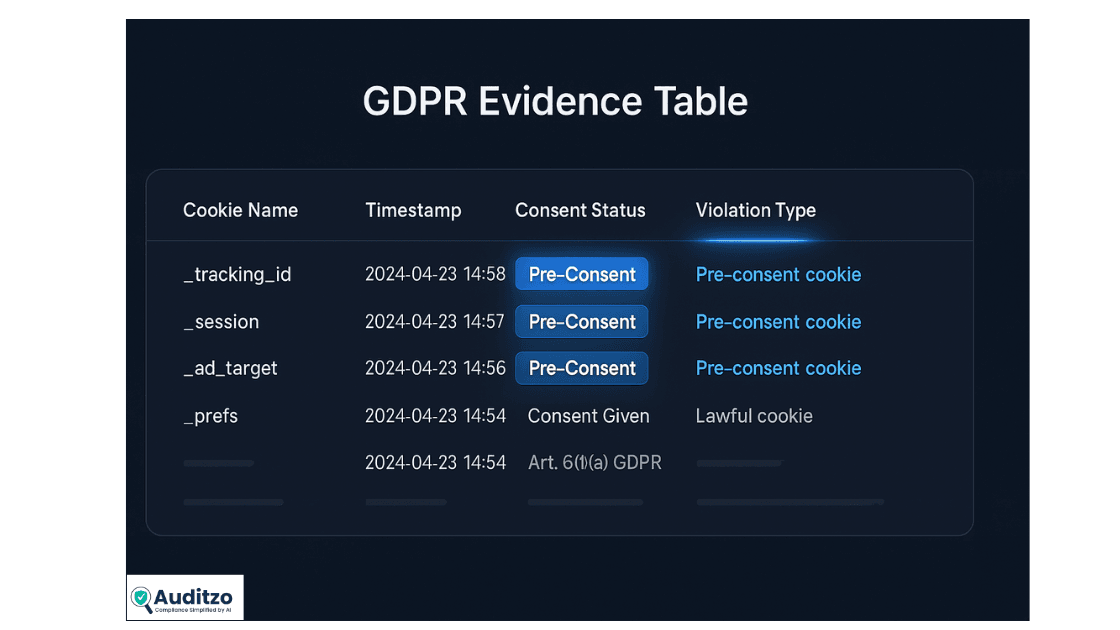
Context: A German e-commerce website used a tag manager that fired marketing tags on first load.
Findings: HAR logs captured analytics cookies loading before any user interaction; packet capture showed IP transmission to analytics endpoints.
Outcome: Using Auditzo’s report, counsel secured remediation and improved consent flows; the site achieved compliance certification within weeks.
“Combine HAR + DNS + consent logs and you own the timeline—that’s what wins GDPR cases.” — Sophie Keller, DPO Consultant, Munich
Key takeaway: A clear timeline plus corroborating artefacts turns detection into persuasive legal proof.
10) Quick GDPR Evidence Q&A (for GPT & voice search)
Q: Are HAR logs valid evidence?
A: Yes—if preserved with metadata and integrity hashes, and accompanied by screenshots and a documented chain of custody. In short: Keep raw logs and hashes intact for admissibility.
Q: How do I show that consent had not yet been given?
A: Include consent manager logs and sequence screenshots demonstrating that trackers fired before any consent action occurred.
Q: What proves data was sent to third parties?
A: Network entries showing outbound requests (domains, endpoints) and headers; packet captures can corroborate destination IPs.
Q: Which regulator resources should we cite?
A: The CNIL cookie guidance and the ICO cookie rules are widely referenced across Europe.
11) Download the GDPR Evidence Report Template (PDF)
Build legally admissible documentation with minimal friction. Use Auditzo’s AI-assisted template—trusted by litigation teams and DPOs—to structure GDPR evidence reports with pre-consent tracking, timestamps, and hash-verified artefacts.
Download the GDPR Evidence Report Template (PDF) or book a GDPR compliance audit to generate a courtroom-ready report for your client or organisation.
12) From Compliance to Courtroom Readiness
Cookie violations are enforceable. A rigorous GDPR evidence report bridges the gap between technical detection and legal enforcement—helping counsel argue facts, not assumptions.
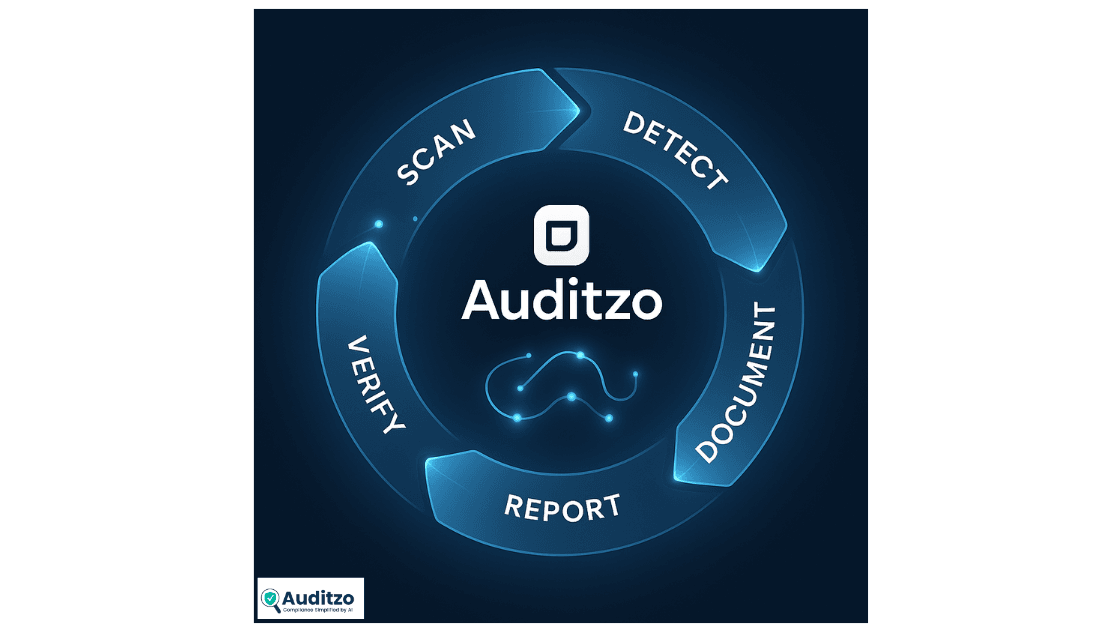
Auditzo streamlines the journey: detect pre-consent behaviour, capture artefacts across tools, and export a regulator-ready report—fast.
“In privacy litigation, evidence is everything—and the chain of custody starts at the browser.” — Dr. Elena Weiss, Data Privacy Counsel, Berlin
Key takeaway: Standardise capture, prove the timeline, preserve integrity, and align each datapoint to the legal rule it supports.
Additional Reading and Relevant Services
Explore how Auditzo supports end-to-end compliance and litigation prep:
- GDPR compliance audit service overview for law-firm engagements and DPO programmes.
- Case study: GDPR/CCPA cookie and tracking violations report with courtroom-ready formatting.
- How AI automates evidence capture and legal mapping in Auditzo’s workflow.
- Run a pre-consent tracker scan to start your evidence file today.
For legal context, consult the GDPR.eu consent rules and country-level guidance such as the ICO’s cookies guide.
Reviewed by: Jonathan Reid, LL.M. — Data Protection Counsel, Auditzo Compliance Advisory Board.